
Welcome to Part 5 of the Smart SEO Series. You’ve mastered keyword research (Part 3) and built a technically solid foundation (Part 4). Now it’s time to measure what matters with the right SEO Tools 2025.
Here’s the truth: most creators drown in data instead of swimming in insights. They subscribe to dozens of tools, track hundreds of metrics, and still can’t answer the simple question: “Is my SEO working?”
This guide cuts through the noise. You’ll learn which SEO Tools 2025 actually deliver results, how to build dashboards that tell you what to do next, and how to turn analytics into growth.
The Real Problem with SEO Tools 2025
Walk into any SEO discussion and someone will recommend their favorite tool stack: Ahrefs, SEMrush, Screaming Frog, Moz, Surfer, Clearscope, plus ten others “you absolutely need.”
The result? Tool paralysis.
You spend hours jumping between platforms, comparing conflicting data, paying for overlapping features, and never actually improving your rankings. The best SEO Tools 2025 aren’t the ones with the most features—they’re the ones you actually use to make better decisions.
Why Tool Overwhelm Kills Progress

Time waste — Checking five dashboards daily takes 2+ hours with no additional insight
Analysis paralysis — Conflicting metrics from different tools confuse rather than clarify
Budget drain — Paying $200-500/month for tools you barely understand
Focus loss — Obsessing over data instead of creating content and fixing issues
The creators who win with SEO Tools 2025 aren’t using the most tools—they’re using the right tools strategically.
Core SEO Tools 2025: The Essential Four
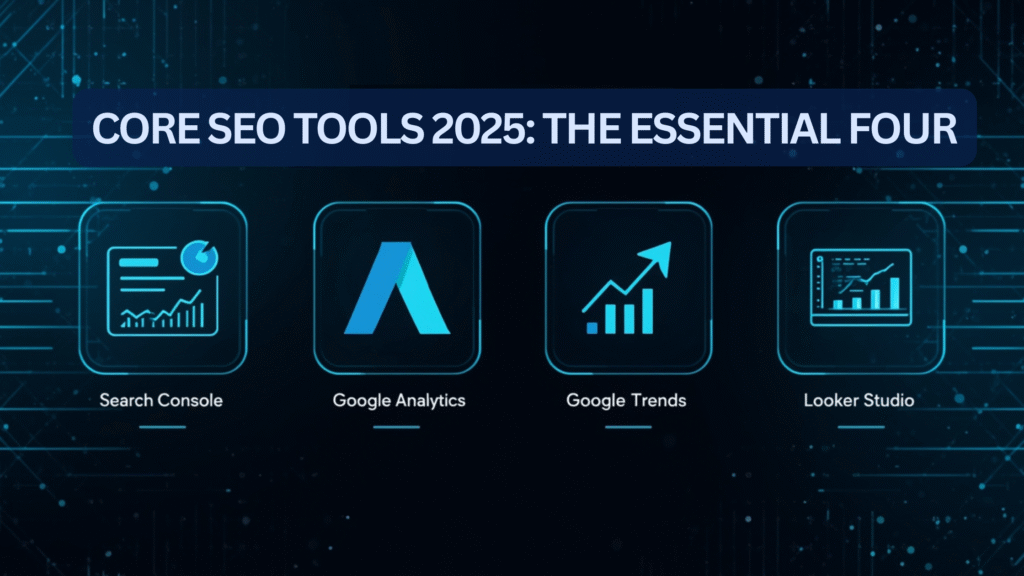
Forget the 20-tool stack. These four SEO Tools 2025 give you 90% of what you need, and three of them are completely free.
1. Google Search Console — Your SEO Command Center
Cost: Free Purpose: See how Google views your site
This is the most underutilized of all SEO Tools 2025, yet it’s the only tool with data straight from Google itself.
What Google Search Console shows you:
Performance data — Every query ranking your pages, exact impressions, clicks, CTR, and position
Index coverage — Which pages Google found, indexed, or blocked
Core Web Vitals — Your actual performance scores for real users
Mobile usability — Issues preventing mobile-first indexing
Manual actions — Google penalties you need to fix immediately
Use it for: Finding which keywords already bring traffic, discovering indexing issues before they hurt rankings, monitoring technical health weekly.
Pro tip: Check GSC every Monday morning. Export your top 100 queries monthly to track progress over time. This single habit separates successful SEO strategies from guesswork.
2. Google Analytics 4 (GA4) — Understanding Your Audience
Cost: Free Purpose: See what users do after clicking
While Search Console shows the journey TO your site, GA4 reveals what happens AFTER users arrive—making it essential among SEO Tools 2025.
What GA4 tells you:
Traffic sources — Which channels (organic, direct, social, referral) drive visitors
User behavior — Pages visited, time spent, conversion paths
Engagement metrics — Scroll depth, video plays, button clicks
Conversions — Goal completions, sign-ups, purchases
Audience insights — Demographics, interests, technology used
Use it for: Identifying which content keeps visitors engaged, finding pages with high bounce rates that need improvement, tracking how SEO traffic converts compared to other channels.
Pro tip: Set up custom events to track specific actions (newsletter sign-ups, downloads, video views). This turns GA4 from a traffic counter into a decision-making tool.
3. Google Trends — Validating Content Ideas
Cost: Free Purpose: Understand search interest over time
Before creating content, use Google Trends to verify that people actually care about your topic—an often-missed step in using SEO Tools 2025 effectively.
What Google Trends reveals:
Interest over time — Is the topic growing, stable, or declining?
Regional popularity — Where your audience concentrates
Related queries — What else your audience searches for
Seasonal patterns — When to publish for maximum impact
Comparison data — Which of two topics has more search demand
Use it for: Validating keyword research by confirming rising interest, timing content publication around seasonal peaks, discovering related topics your audience cares about.
Pro tip: Compare “Topic” (all related searches) vs “Search term” (exact phrase) to see broader interest. A declining search term might still be part of a rising topic.
4. Looker Studio (Google Data Studio) — Visual Dashboard Creation
Cost: Free Purpose: Combine data sources into actionable dashboards
Looker Studio transforms the raw data from your other SEO Tools 2025 into visual dashboards that tell you exactly what’s working.
What Looker Studio does:
Data integration — Connect GSC, GA4, Google Ads, Sheets in one view
Custom visualizations — Charts, tables, scorecards showing your KPIs
Automated reporting — Updated dashboards without manual data entry
Shareable insights — Send reports to clients or team members
Time comparison — Track changes month-over-month automatically
Use it for: Building a single dashboard showing clicks, impressions, CTR, and conversions together, creating weekly/monthly reports without manual work, spotting trends across multiple metrics simultaneously.
Pro tip: Start with one simple dashboard—don’t try to visualize everything at once. Your first dashboard should answer: “How is my organic traffic performing this month compared to last month?”
Common Mistakes with SEO Tools 2025
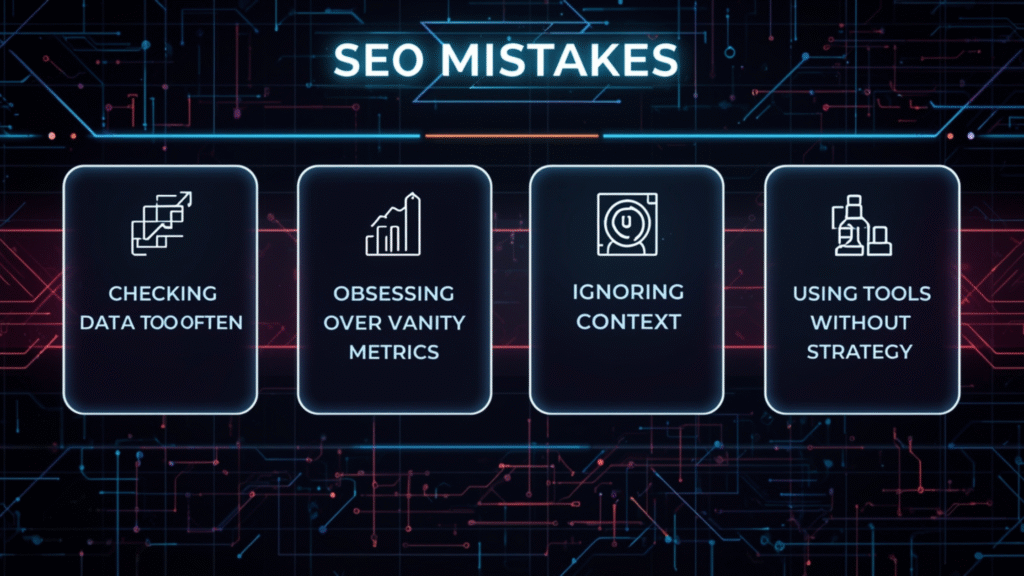
Even with the best SEO Tools 2025, most people make these errors that waste time and create confusion.
Mistake 1: Checking Data Too Often
The problem: Looking at GSC every few hours creates anxiety without insight. SEO changes take weeks to manifest.
The solution: Check your dashboard once weekly. Make decisions monthly. SEO is a marathon, not a sprint.
Mistake 2: Obsessing Over Vanity Metrics
The problem: Celebrating 1 million impressions while ignoring that only 5,000 clicked (0.5% CTR).
The solution: Focus on metrics that matter: clicks, conversions, revenue. Impressions alone don’t pay bills.
Mistake 3: Ignoring Context
The problem: “My traffic dropped 30% this week!” (It’s Thanksgiving week—everyone’s traffic dropped.)
The solution: Always compare to the same period last year. Understand seasonality. Look at trends, not single data points.
Mistake 4: Using Tools Without Strategy
The problem: Buying Ahrefs, SEMrush, and Moz but never actually implementing what they suggest.
The solution: Master free SEO Tools 2025 first. Only pay for premium tools when you’re implementing 100% of what free tools tell you.
Mistake 5: Tracking Everything, Improving Nothing
The problem: Monitoring 50 metrics but never taking action based on data.
The solution: Track 5-10 KPIs. Every time you review data, identify ONE action to take. Data → Decision → Action.
Conclusion: From Data to Decisions to Growth
The best SEO Tools 2025 aren’t the most expensive or the most feature-rich. They’re the ones that help you make better decisions faster.
You don’t need 20 tools. You need 4 good ones used strategically:
- Google Search Console for Google’s view of your site
- Google Analytics 4 for user behavior insights
- Google Trends for content validation
- Looker Studio for unified dashboards
Most importantly, you need a system: weekly reviews, data-driven decisions, consistent action, and patience for results.
You’ve now completed the Smart SEO Series foundation—analytics (Part 1), Google’s ranking system (Part 2), keyword research (Part 3), technical SEO (Part 4), and tools/dashboards (Part 5). You have everything you need to grow your organic traffic systematically.
The difference between creators who succeed with SEO and those who don’t isn’t talent or budget—it’s having a clear system and following it consistently. Your SEO Tools 2025 dashboard is that system.
Now stop collecting tools and start using the ones you have.