
Keyword Research 2025 is no longer just about search volume — it’s about understanding audiences, behaviour, competition, and intent. Modern SEO requires using analytics, real user signals, and AI-ready content frameworks to choose keywords that actually convert.
🔄 Quick Recap of Part 2 — How Google Ranks Websites in 2025
In Part 2 of the Smart SEO Series by informativehive, we saw how Google’s ranking systems have evolved into:
- AI-driven evaluation
- Intent understanding
- Experience & authority scoring
- SGE (Search Generative Experience) overviews
- Entity-based understanding
This means keyword research must now match intent, expertise, and topic depth — not just include keywords.
3.1 Why Traditional Keyword Research is Outdated
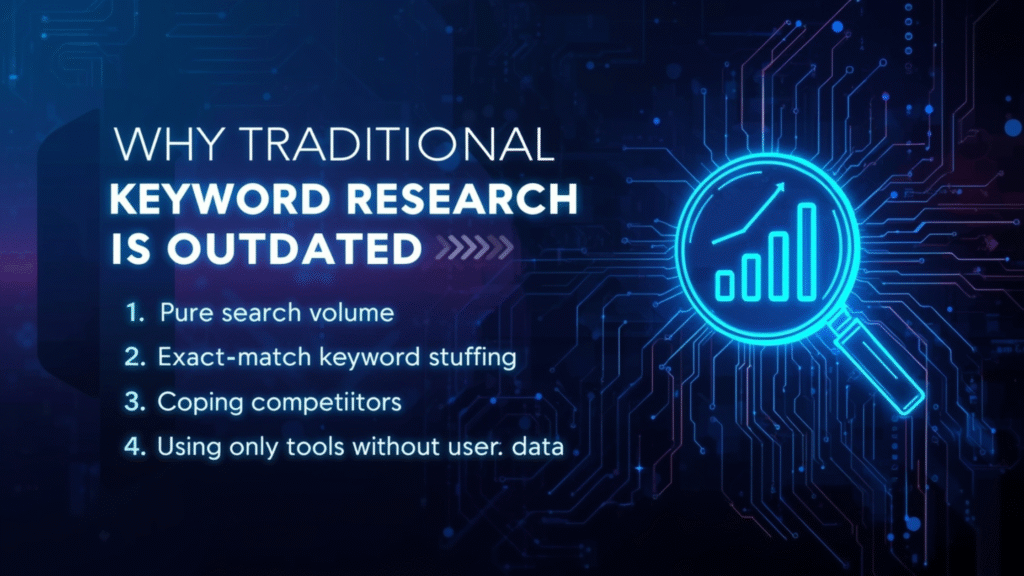
Traditional keyword research methods no longer work in Keyword Research 2025.
Old SEO approaches focused on:
- chasing search volume instead of understanding user needs
- stuffing exact-match keywords to manipulate rankings
- copying whatever competitors were ranking for
- depending solely on tools without analysing real user behaviour
But in Keyword Research 2025, these methods fail.
Google’s AI-driven SERPs, SGE overviews, and personalized search results emphasize:
- intent match over keyword match
- depth over density
- topical authority over shallow posts
- user satisfaction over keyword tricks
If your keywords don’t align with the real question, motivation, and journey of the user, they simply won’t rank — no matter how “high volume” they are.
3.2 Understanding Keyword Intent & the Search Journey
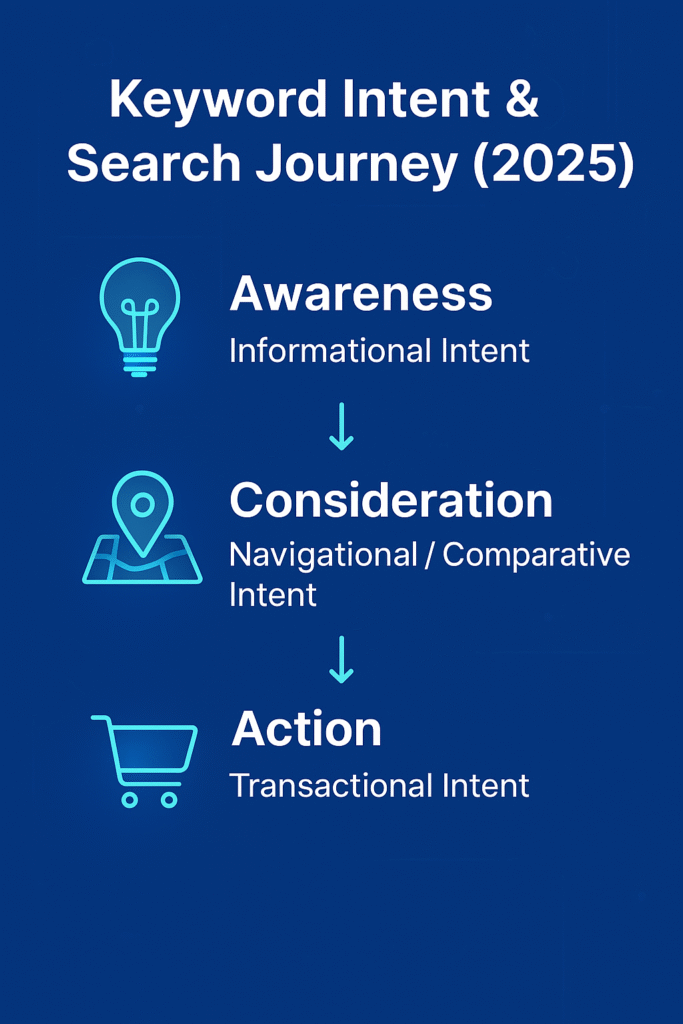
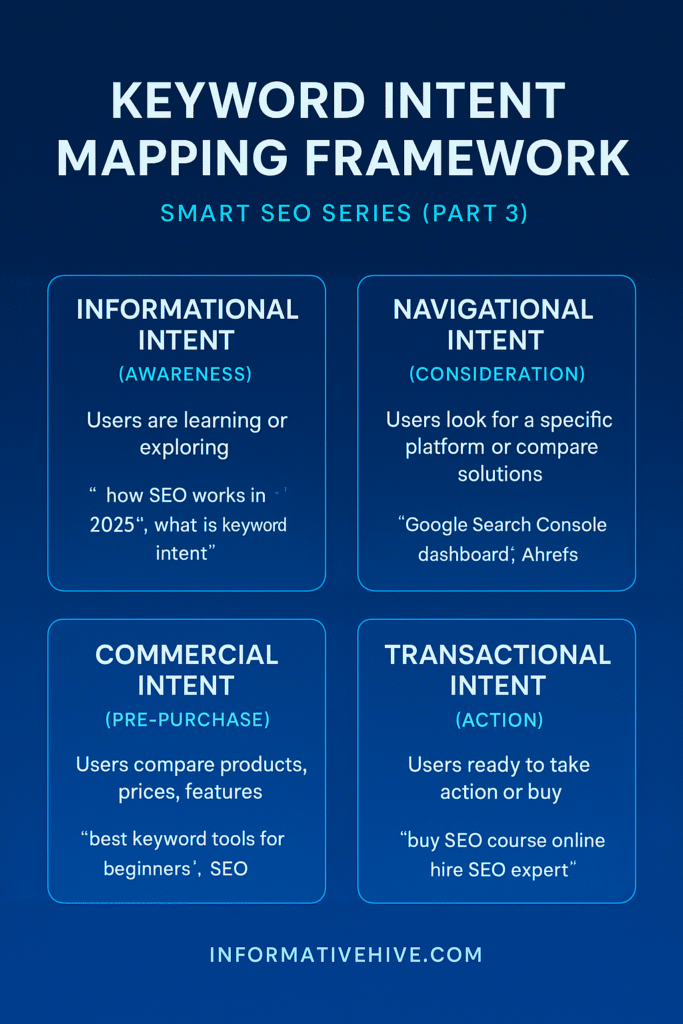
Effective keyword research 2025 is no longer just about finding high-volume terms — it’s about understanding why users search and aligning your content with their intent. Modern SEO strategy revolves around mapping content to the searcher’s journey, ensuring every piece of content meets users where they are.
🔹 Awareness Stage (Informational Intent)
At the awareness stage, users are discovering or learning about a topic. They are exploring, researching, or seeking answers, not ready to buy or take action. The goal here is to provide educational and valuable content that answers questions clearly.
Characteristics:
- Queries often start with “what,” “how,” “why,” or “guide.”
- Users want insights, tutorials, or general knowledge.
- Content should be informative, approachable, and easy to digest.
Examples:
- “how SEO works in 2025”
- “what is data-driven keyword research”
- “beginner’s guide to on-page SEO”
- “tips to improve website ranking organically”
Content Strategy:
- Blog posts, guides, tutorials, explainer videos.
- Focus on solving problems or answering questions comprehensively.
- Use visuals, infographics, and examples to make complex topics easier to understand.
🔹 Consideration Stage (Navigational/Comparative Intent)
Once users understand a topic, they move to the consideration stage, where they evaluate options, compare tools, or explore solutions. This is the research phase before making a decision.
Characteristics:
- Queries often include words like “best,” “vs,” “compare,” or “review.”
- Users are looking for insights to make informed decisions.
- Content should highlight differences, pros/cons, and features.
Examples:
- “best keyword tools for beginners”
- “Ahrefs vs SEMrush comparison”
- “top SEO analytics software 2025”
- “free vs paid keyword research tools”
Content Strategy:
- Comparison articles, case studies, and reviews.
- Include clear benefits, use cases, and pricing.
- Provide interactive elements like tables, charts, or decision guides to help users evaluate options.
🔹 Action Stage (Transactional Intent)
At the action stage, users are ready to take a concrete step — hiring, purchasing, or signing up. This is the stage where content directly supports conversions.
Characteristics:
- Queries are often transactional: including words like “buy,” “hire,” “pricing,” or “services.”
- Users have already researched and are seeking the best solution to act on immediately.
- Content should be persuasive, clear, and easy to act upon.
Examples:
- “hire SEO consultant in India”
- “best keyword research tools pricing”
- “subscribe to premium SEO software”
- “purchase AI content optimization tool”
Content Strategy:
- Product pages, service pages, landing pages.
- Clear call-to-actions (CTAs), pricing details, and benefits.
- Testimonials, case studies, and trust signals to reduce friction in decision-making.
3.3 Best Tools for Modern Keyword Research
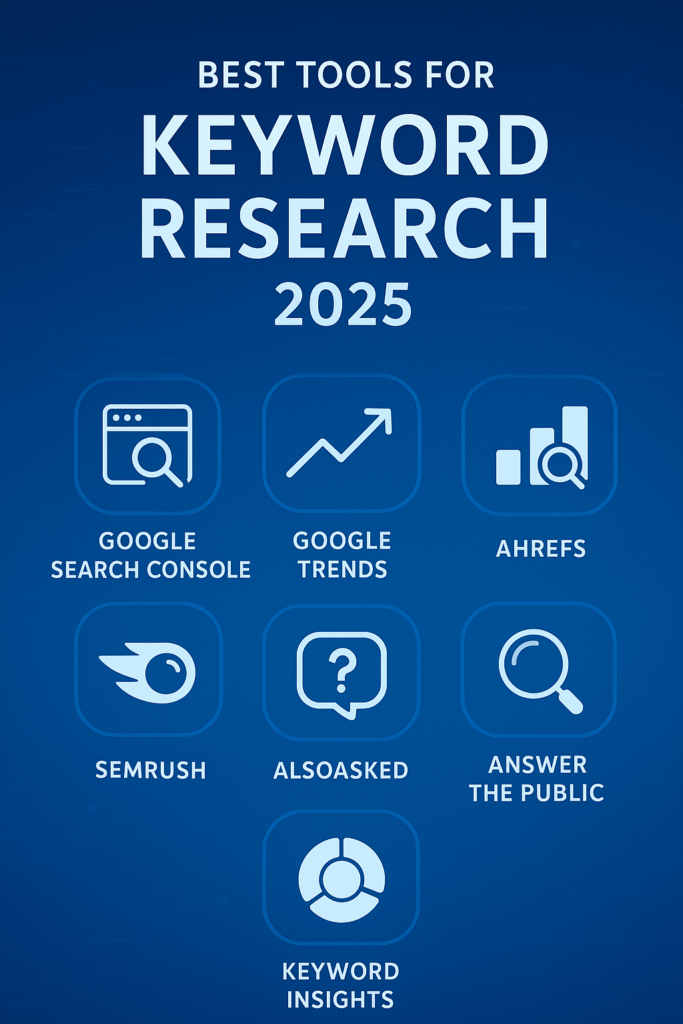
A smart Keyword Research 2025 approach uses multiple tools, combining SEO data, user behaviour insights, and real-time trends to uncover high-value keywords that actually perform.
- Google Search Console (GSC): Real impressions & CTR
- Google Trends: Demand shifts
- Ahrefs / Semrush: Volume, difficulty, clicks
- AlsoAsked / AnswerThePublic: Question-based keywords
- Keyword Insights: Clustering & intent grouping
Goal: find keywords people actually search AND match them with content that solves their problem.
3.4 Using Analytics to Refine Keywords
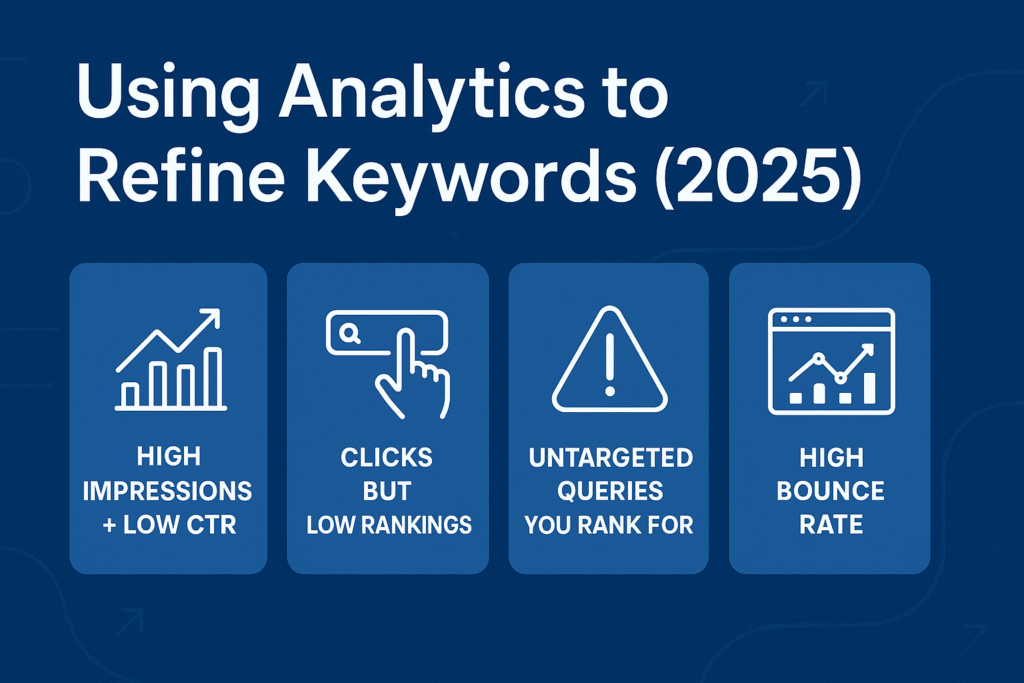
This is where real data beats guesswork.
Look for insights like:
- High impressions + low CTR → Rewrite title & meta
- Clicks but low rankings → Improve on-page SEO
- Ranking for untargeted keywords → Create new content
- High bounce rate → Intent mismatch
Keyword Research 2025 becomes a continuous loop of measurement and refinement.
3.5 Building a Keyword Strategy for 2025
A smart, data-driven Keyword Research 2025 approach uses multiple tools:
✔ Create topic clusters
Pillar pages with interconnected subtopics.
✔ Focus on long-tail keywords
Higher intent + better conversion.
✔ Build topical authority
Cover related subjects deeply and consistently.
✔ Optimize for SGE
Clear, structured content that answers queries directly.
3.6 Common Mistakes to Avoid
❌ Keyword stuffing
❌ Targeting only high-volume keywords
❌ Ignoring search intent
❌ Blind competitor copying
❌ Not using analytics
❌ Creating content with no real value
Keyword Research 2025 requires depth, authenticity, and real problem-solving — not shortcuts.
📌 Part 4 Teaser — What’s Coming Next
Up next in the Smart SEO Series:
Part 4 — Technical SEO Simplified for Creators
You’ll learn:
- How to fix technical issues that block rankings
- Core Web Vitals for 2025
- SGE-optimized site structure
- Crawlability & indexing essentials
- Speed, schema, sitemaps & more
Stay tuned — Part 4 will make technical SEO simpler than ever.
Pingback: SEO Roadmap 2025: Complete Guide — Smart SEO Series
Pingback: Technical SEO 2025 Simplified – Smart SEO Series: Part 4
Pingback: Ultimate SEO Tools 2025 Guide – Smart SEO Series: Part 5