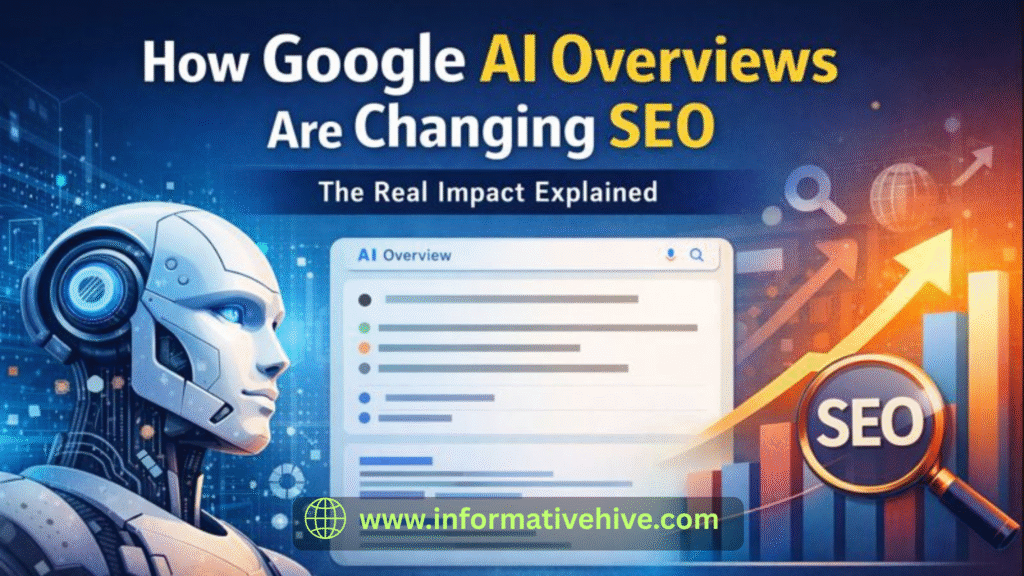
Google search is changing faster than ever. With the introduction of Google AI Overviews, users are now getting direct, AI-generated answers at the top of search results — often without clicking a single link.
For website owners, marketers, and SEOs, this raises an important question:
Is SEO still effective in the age of AI Overviews?
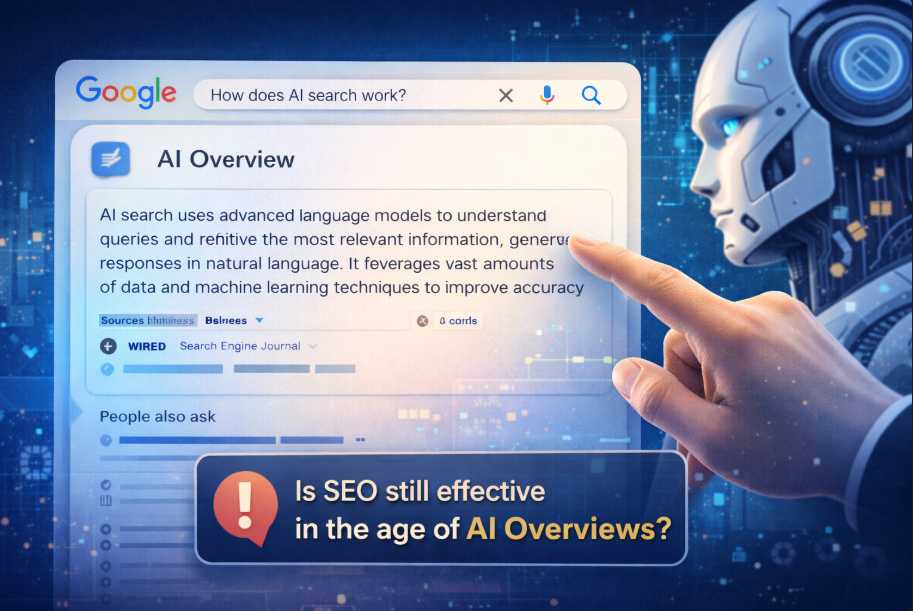
Let’s break down what Google AI Overviews are, how they impact SEO in the real world, and what you should do next.
What Are Google AI Overviews?
Google AI Overviews are AI-generated summaries that appear at the top of search results for certain queries.
Instead of showing just blue links, Google now provides:
- A summarized answer
- Key points pulled from multiple sources
- Links cited below the AI response
These overviews are powered by advanced language models and are designed to answer questions faster.
Why Did Google Introduce AI Overviews?
Google’s goal is simple: improve user experience.
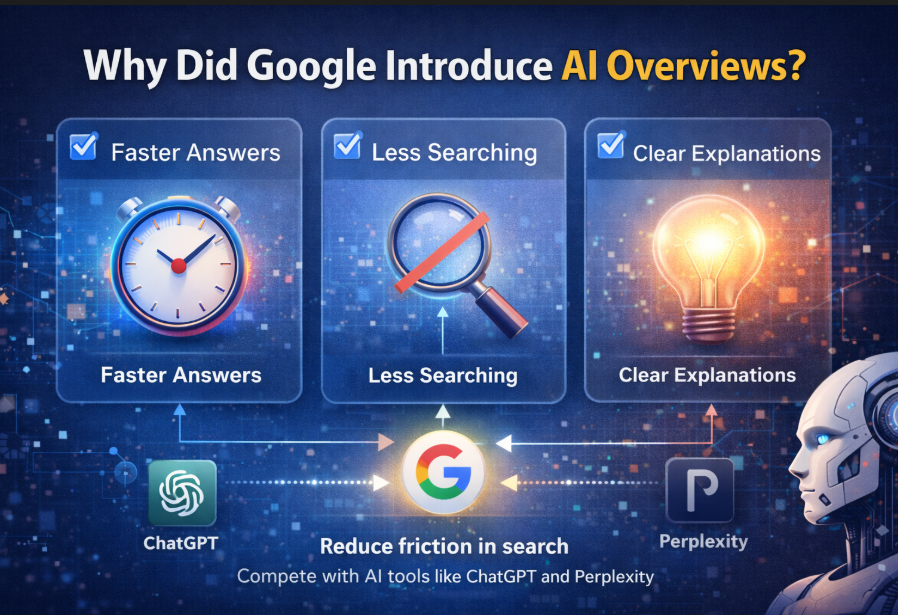
Users increasingly want:
- Faster answers
- Less searching
- Clear explanations
AI Overviews help Google:
- Reduce friction in search
- Compete with AI tools like ChatGPT and Perplexity
- Keep users inside Google longer
From Google’s perspective, this is a logical evolution.
From an SEO perspective, it’s disruptive.
How Google AI Overviews Are Affecting SEO (Real Impact)
1. Reduced Click-Through Rates (CTR)
Many informational searches now get answered directly on the SERP.
Users often don’t need to click a website anymore.
This leads to:
- More zero-click searches
- Fewer visits for simple informational content
2. Visibility Is Replacing Traffic
Even if clicks drop, brand visibility still matters.
Websites featured in AI Overviews:
- Gain credibility
- Build authority
- Stay top-of-mind for users
SEO is slowly shifting from traffic-only metrics to presence and trust.
3. Content Quality Matters More Than Ever
AI Overviews pull information from:
- Well-structured content
- Trusted sources
- Pages with clear explanations
Thin, generic, or AI-spun content is less likely to be used.
4. Informational Queries Are Most Affected
Queries like:
- “What is…”
- “How does…”
- “Why does…”
are most likely to trigger AI Overviews.
Transactional and commercial searches are less affected (for now).
Who Is Most Impacted by AI Overviews?
- Blogs relying heavily on basic informational content
- Affiliate sites with shallow explanations
- Websites chasing keywords instead of authority
Websites that add original insight, experience, or depth are more resilient.
What Still Works in SEO After AI Overviews
Despite the changes, SEO is not dead. It’s evolving.
What still works:
✅ Topical Authority
Google now prefers websites that fully understand a topic, not pages that just target one keyword.
What this means:
- Cover a topic end-to-end, not just the basics
- Create content clusters instead of isolated posts
- Interlink related articles to show expertise
Example:
Instead of writing only “What are AI Overviews?”, also cover:
- AI Overviews vs featured snippets
- SEO impact of AI Overviews
- How to optimize content for AI answers
When Google’s AI looks for trusted sources, it favors sites that demonstrate consistent depth, not one-off articles.
✅ Original Insights
AI Overviews don’t reward content that simply rephrases what already exists.
What works now:
- Real-world examples
- Personal observations
- Case studies
- Practical recommendations
Why this matters:
AI-generated summaries rely on distinct perspectives.
If your content adds nothing new, there’s no reason for Google to reference it.
Even simple insights like:
“In my experience, informational pages saw lower CTR, but brand impressions increased.”
can make your content more valuable than generic AI-written posts.
✅ Structured Content
Well-structured content is easier for:
- Users to read
- Google AI to understand and summarize
Best practices:
- Clear H2 and H3 headings
- Bullet points for key ideas
- Short, focused paragraphs
- FAQ-style explanations where relevant
Structured content increases the chances of:
- Being cited in AI Overviews
- Appearing in snippets
- Improving overall readability
Think of it this way:
If an AI had to explain your article in 3 lines — could it?
✅ Trust Signals
With AI-generated answers, trust matters more than clicks.
Google looks for:
- Clear author information
- Accurate, up-to-date content
- Transparent explanations
- No exaggerated or misleading claims
Strong trust signals include:
- About & author pages
- Consistent publishing
- Honest disclaimers
- Content written with intent to help, not just rank
AI Overviews prioritize reliable sources — not just optimized pages.
How Website Owners Should Adapt
Here’s how to future-proof your SEO:
- Stop chasing low-effort informational keywords
- Focus on why, how, and what to do next
- Build content clusters instead of isolated posts
- Write for humans first, AI second
- Think beyond clicks — think authority
SEO is no longer just about ranking.
It’s about being referenced.
AI Overviews, AEO, and the Future of SEO
This shift is pushing SEO toward Answer Engine Optimization (AEO).
Instead of asking:
“How do I rank first?”
We now ask:
“How do I become the best answer?”
This aligns closely with emerging concepts like LLMS.TXT, where websites start optimizing for AI understanding — not just search engines.
Final Thoughts
Google AI Overviews are changing SEO, but they are not killing it.
They reward:
- Depth over volume
- Authority over automation
- Value over keywords
If you adapt early, this change can become an advantage — not a threat.
SEO isn’t disappearing.
It’s simply growing up.