Introduction
SEO is no longer just about ranking links on Google.
Today, people are getting answers from AI systems like Google AI Overviews, ChatGPT, Gemini, and Perplexity — often without ever clicking a website. This shift has raised an important question for website owners and marketers:
How do AI models read, understand, and use our content?
That’s where LLMS.TXT enters the conversation.
It is an emerging concept that aims to give website owners more clarity and control over how large language models (LLMs) interact with their content. While it is not yet an official standard, it represents a growing movement toward AI-aware SEO.
In this article, we’ll explore:
- What LLMS.TXT is (in simple terms)
- Why it’s gaining attention now
- How it differs from robots.txt
- Whether it matters for SEO today
- And how it fits into the future of search
What Is LLMS.TXT?
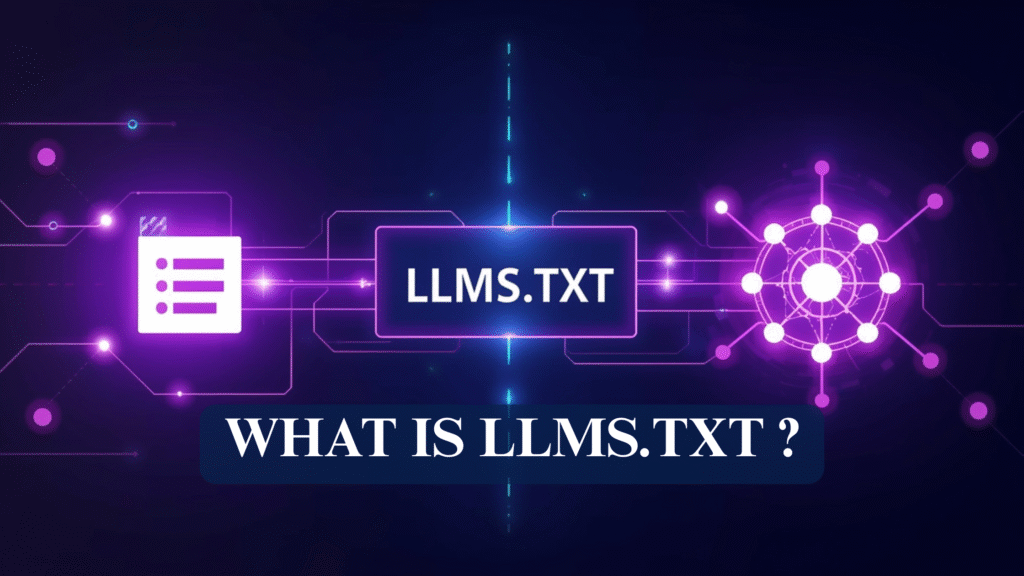
LLMS.TXT is a proposed text-based file that allows websites to communicate guidelines to AI language models about content access and usage.
In simple terms:
It is an attempt to define how AI systems should interact with a website’s content.
It is conceptually similar to:
- robots.txt → controls search engine crawling
- sitemap.xml → helps discover pages
But it is focused on AI consumption, not traditional indexing.
The idea is to help clarify:
- Whether AI models can read certain pages
- Which sections should be excluded
- How content may be summarized or reused
At this stage, it is not officially adopted by Google or OpenAI, but it reflects a very real concern among publishers and SEOs.
Why LLMS.TXT Is Becoming Relevant Now
This discussion didn’t appear randomly. It’s a response to real changes in how people access information.
Key shifts happening right now:
- AI-generated answers are replacing search clicks
- Content is summarized instead of visited
- Attribution is inconsistent
- Website traffic patterns are changing
As AI systems become intermediaries between users and websites, publishers want:
- Transparency
- Attribution
- Control
It is part of that conversation.
Even if this exact format evolves or gets replaced, the underlying problem it addresses is not going away.
LLMS.TXT vs Robots.txt: A Clear Comparison
This is where many people get confused.
| Aspect | robots.txt | LLMS.TXT |
| Designed for | Search engine crawlers | AI language models |
| Controls indexing | Yes | No |
| Affects rankings | Yes | Not directly |
| Official standard | Yes | No (yet) |
| Focus | Crawling & indexing | Content usage & AI interaction |
Robots.txt tells search engines what they can crawl.
It is about how AI systems should use content, not how pages rank.
Does LLMS.TXT Impact SEO Today?
Directly? No.
Strategically? Yes.
Google has not confirmed LLMS.TXT as:
- A ranking factor
- A crawling directive
- A search requirement
However, SEO itself is evolving.
Search visibility is no longer limited to:
- Blue links
- Page-one rankings
It now includes:
- AI summaries
- Answer engines
- Zero-click visibility
It aligns with this shift toward Answer Engine Optimization (AEO).
LLMS.TXT and the Rise of AEO (Answer Engine Optimization)
Traditional SEO focused on:
- Keywords
- Backlinks
- Metadata
Modern discovery focuses on:
- Clear answers
- Context
- Authority
- Trust signals
AI systems prioritize:
- Well-structured content
- Direct explanations
- Credible sources
- Consistent topical coverage
It fits into this broader transition — not as a ranking tool, but as a signal of intent and preparedness for AI-driven discovery.
Should Website Owners Implement LLMS.TXT Now?
This depends on your goals.
You should consider it if:
- You publish original research or deep insights
- You care about AI attribution and ethical use
- You want to stay ahead of SEO trends
- Your site already follows SEO best practices
You can safely wait if:
- Your site is new or small
- You’re still fixing basic SEO issues
- You prefer official standards only
For most sites, LLMS.TXT is optional, not essential — but understanding it is valuable.
What Matters More Than LLMS.TXT Right Now
Instead of focusing only on a new file, prioritize fundamentals that help both SEO and AI visibility:
- Clear content structure (H1–H3)
- Direct answers to user questions
- Strong topical authority
- Human-edited, experience-driven content
- Author transparency and trust pages
- Internal linking across related topics
These factors matter today, regardless of how LLMS.TXT evolves.
Is LLMS.TXT the Future of SEO?
LLMS.TXT itself may change.
But the idea behind it is already shaping the future:
Websites optimizing not just for search engines, but for AI systems that explain the web.
SEO is no longer about gaming algorithms.
It’s about helping machines understand meaning, context, and credibility.
LLMS.TXT is one signal in that direction.
Final Thoughts
LLMS.TXT is not a shortcut.
It won’t magically increase rankings or traffic.
But it represents a mindset shift — from ranking pages to being referenced by intelligent systems.
For SEOs and digital marketers who want to stay relevant in the AI era, understanding concepts like LLMS.TXT isn’t optional anymore.
It’s preparation.