
How Google Ranks Websites in 2025 — Welcome to Part 2 of our Smart SEO Series, where we decode the real ranking factors that influence modern search visibility. In this chapter, you’ll learn how AI, algorithms, and search intent shape Google’s ranking system today.
Quick Recap of Part 1:
In Part 1, we explored why SEO analytics matters, how data reveals what your audience truly wants, and how smart analysis helps you optimize pages, track performance, and make evidence-based SEO decisions. We also covered the 4 key metrics every beginner should focus on: impressions, clicks, CTR, and rankings — the foundation of data-led SEO.
In this section of our SEO Roadmap 2025, How Google Ranks Websites in 2025 — we break down how modern algorithms, AI systems, and user intent shape search rankings today. You’ll understand how Google evaluates content, align yo ur pages with intent, and build genuine authority in your niche.
How Google Ranks Websites in 2025 — by the end of this guide, you’ll know exactly what Google cares about and how to optimize your content for both humans and AI.
➡ Focus: Ranking factors decoded.
Introduction: How Google Ranks Websites in 2025
How Google Ranks Websites in 2025: Google’s ranking system is powered by AI, machine learning models, and search intent signals that help the search engine understand what users want — not just what keywords appear on a page.
If you understand how Google ranks websites in 2025, you can align your content with what Google truly rewards: expertise, originality, trust, user satisfaction, and intent fulfilment.
This chapter decodes how Google ranks websites in 2025 by breaking down the key ranking factors Google uses today and how you should adapt your SEO strategy for the new era of AI Search.
2.1 Evolution of Google’s Algorithm
How Google Ranks Websites in 2025 has evolved from simple keyword matching to advanced AI-driven interpretation.
A quick timeline:
- 2011 – Panda: Quality filter; penalized thin or duplicate content.
- 2013 – Hummingbird: Improved understanding of search phrasing.
- 2015 – RankBrain: Introduced machine learning to interpret queries.
- 2018 – BERT: Helped Google understand context and natural language.
- 2021+ – MUM (Multitask Unified Model): AI capable of multimodal reasoning.
- 2023–2025 – SGE (Search Generative Experience): AI-powered overviews changing how search results are delivered.
What this means in 2025:
How Google Ranks Websites in 2025 — it doesn’t just scan your text. It interprets, analyzes, and rates content using AI models that understand:
- Meaning
- Intent
- Structure
- Experience
- Authority
Keyword tricks don’t work anymore — real value does.
2.2 AI in Search: How Google Understands Content
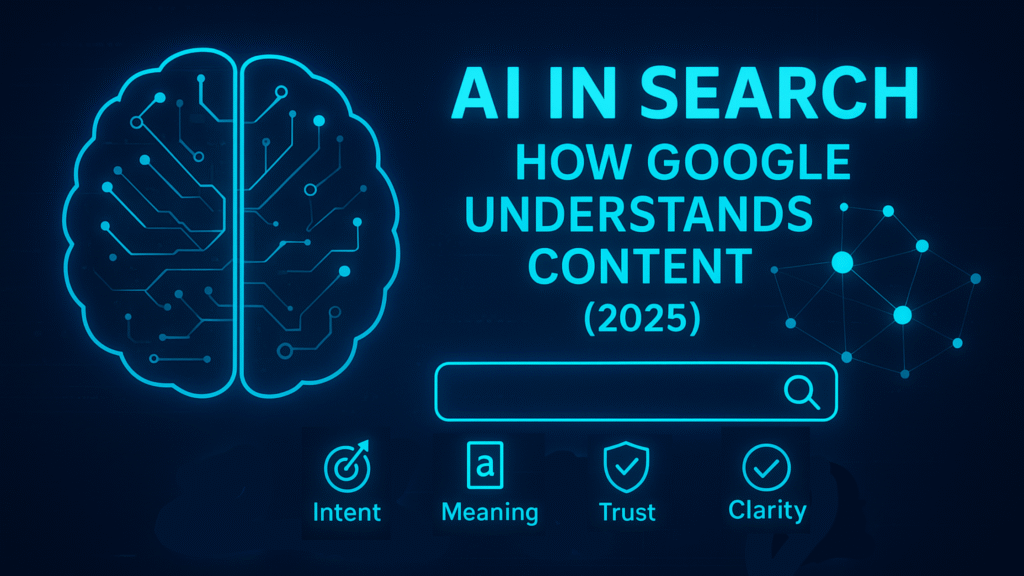
Google’s 2025 ranking systems use AI to understand:
- The topic you’re covering
- The depth of your explanation
- The intent behind your content
- Whether you’re a trustworthy source
AI now evaluates:
- Semantic meaning, not keyword density
- Your writing tone (expert, helpful, surface-level, spammy)
- The relationships between entities (people, places, topics)
- Whether your answer truly solves the query
Your content must feel:
✔ Helpful
✔ Clear
✔ Accurate
✔ Unique
✔ Trustworthy
If it looks like rewritten AI junk → it will not rank.
2.3 Understanding User Intent
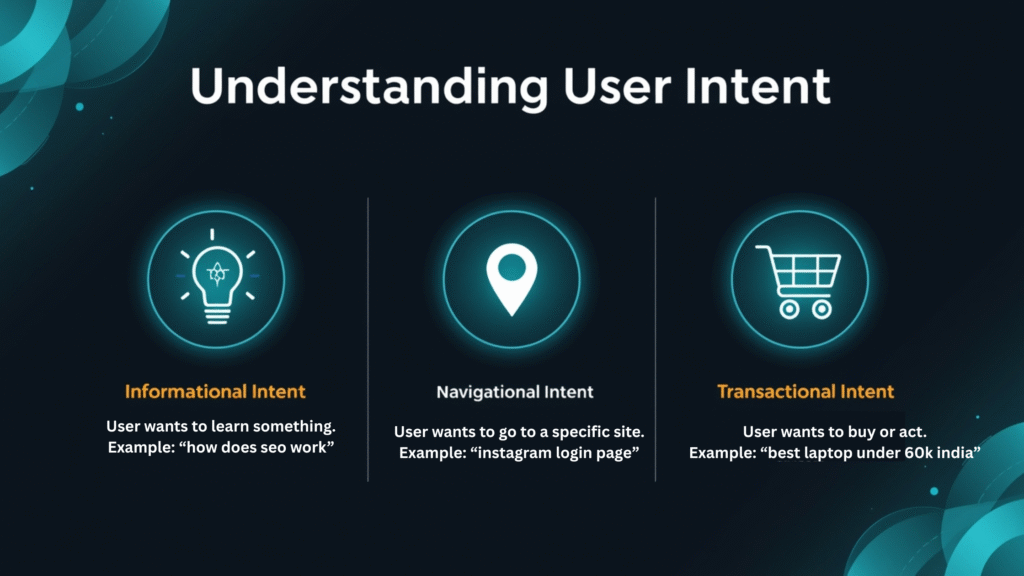
In 2025, search intent is the #1 ranking factor.
Every query falls under one of these types:
🔹 Informational Intent
User wants to learn something.
Example: “how does seo work”
🔹 Navigational Intent
User wants to go to a specific site.
Example: “instagram login page”
🔹 Transactional Intent
User wants to buy or act.
Example: “best laptop under 60k india”
Google checks:
- Does your content match the intent?
- Are you giving the user exactly what they’re searching for?
- Is it structured clearly so they find answers fast?
Intent-aligned content = higher rankings.
2.4 Ranking Factors That Still Matter (and Always Will)
Even with AI and SGE, Google still relies heavily on foundational ranking signals:
🔸 EEAT (Experience, Expertise, Authoritativeness, Trustworthiness)
Google wants proof:
- You know your topic
- You have real experience
- Others trust your content
🔸 Mobile-First Indexing
Your site must load fast and function perfectly on mobile.
🔸 Core Web Vitals
Google measures:
- Loading speed
- Visual stability
- Interactivity
🔸 Backlinks
Still valuable — but ONLY when:
- Relevant
- Natural
- High-quality
🔸 Engagement Signals
Google tracks how users behave:
- Do they stay on your page?
- Do they bounce?
- Do they scroll and interact?
Satisfied users → Stronger rankings.
2.5 Aligning Your SEO Strategy for 2025
Here’s how to structure content that ranks today:
✔ Start With Intent
Create content for the user, not for keywords.
✔ Add First-Hand Experience
- Case studies
- Data
- Personal expertise
- Real examples
This boosts EEAT instantly.
✔ Use Clear Formatting
- Short paragraphs
- Bullet points
- Headings
- FAQs
Easy-to-read content = better AI interpretation.
✔ Optimize for SGE
- Concise summaries
- Definitions
- Step-by-step formats
- Fact-checked information
✔ Strengthen Topical Authority
Build content clusters around specific themes instead of writing random blogs.
AI favors websites that show depth, not breadth.
2.6 Common Misconceptions (Debunked)
❌ “AI will replace SEO.”
No. AI is changing SEO, not killing it.
Humans still set strategy, provide expertise, and create real value.
❌ “More keywords = better ranking.”
Wrong. Keyword stuffing is outdated and penalized.
❌ “Backlinks alone can rank you.”
Not anymore. Relevance and authority matter more than volume.
❌ “Longer content always ranks higher.”
Length doesn’t matter — clarity and helpfulness do.
❌ “SGE makes ranking useless.”
SGE actually rewards high-quality sites and expert creators.
Final Thoughts
How Google Ranks Websites in 2025: Google’s ranking systems are smarter, stricter, and more user-focused than ever. If you can align your content with these signals, you’ll stay ahead in search results.
If you can:
- Match intent
- Provide value
- Show expertise
- Optimize for AI
…you’ll outrank even bigger websites.
This sets the stage for Part 3, where we discuss:
👉 Keyword Research With a Data-Driven Twist
How to find keywords that actually rank in the SGE era.
Pingback: SEO Roadmap 2025: Complete Guide — Smart SEO Series
Pingback: Keyword Research 2025: A Data-Driven Guide for Smarter SEO